Building an Autonomous Trucking Company
Brett Suma
My first 100 days at Bot Auto
I came to Bot Auto with a developed thesis about autonomous trucking. I did not believe the autonomous truck itself was the product. I believed autonomous capacity was the product, and that the winners in this industry would ultimately be determined by who could turn extraordinary autonomous driving technology into a scalable transportation network.
My first 100 days haven't changed that thesis. They have reinforced it—and given us a much clearer roadmap for putting it into practice.
I spent 20 years at Knight Transportation, and it is difficult to overstate how much of my understanding of trucking was formed there. Knight taught me how transportation businesses scale. I learned the importance of density, utilization, asset productivity, operating discipline and customer service. Most importantly, I learned to stop thinking about individual trucks and start thinking about networks.
A truck is an asset, and a network determines how productive that asset can become.
After Knight, I started Loadsmith, which gave me a very different education. Starting with a blank sheet of paper taught me how quickly a company can move when it isn't constrained by legacy systems, processes and assumptions. We could identify a problem, build technology around it, put it in customers' hands, learn and iterate quickly.
Large incumbents have enormous advantages in capital, customers, infrastructure and scale. But those advantages can also create organizational weight. A startup has to capitalize on a different advantage: speed.
Knight taught me scale. Loadsmith taught me speed. Bot's success in autonomous trucking will require both.
What has become clear to me during my first 100 days is just how important Bot's technological foundation will be to our ability to scale. We are building this company at a unique moment in artificial intelligence, and I believe that timing gives us an advantage.
Autonomous trucking is often viewed as a race where the companies that started first must naturally be the furthest ahead. I'm not convinced that will determine who ultimately wins. Some of our comparators began developing autonomous vehicles many years before Bot existed. That experience has value, but it also means portions of their technology and organizations were built during an earlier generation of computing and AI.
Bot is being built differently. We are building in the middle of an AI revolution, with the ability to apply today's technology from the ground up—not only to the autonomous driving system, but across the entire company.
We are applying AI throughout the business—in engineering, operations, network development, analysis and decision-making. Our opportunity is to build an AI-native transportation company, not simply a transportation company operating an AI-powered truck or layering AI onto legacy systems and processes.
That distinction matters because AI doesn't just change what the truck can do. It changes how quickly the entire organization can learn, build and improve. In a rapidly changing technology environment, I believe rate of improvement matters more than starting position.
Technology also has a direct relationship to the transportation business we can build. Every technological constraint eventually becomes an operational constraint, and every operational constraint eventually becomes an economic one. If an autonomous truck requires narrowly defined operating conditions, specialized infrastructure, frequent human intervention or complicated handoffs, the transportation network has to be designed around those limitations.
As those technological constraints disappear, the transportation network becomes less constrained as well. More origins and destinations become accessible, operations become simpler, assets can become more productive and new markets can be added faster.
That is why I don't view Bot's technological advantage simply as an engineering advantage. I view it as a scaling advantage.
Much of my first 100 days has been about translating that technological capability into a transportation business. There is a significant difference between proving that an autonomous truck can safely travel from Point A to Point B and building a transportation system capable of repeatedly putting the right capacity in the right place, at the right time, for a customer willing to pay for it.
The first is an extraordinary engineering achievement. The second is a business.
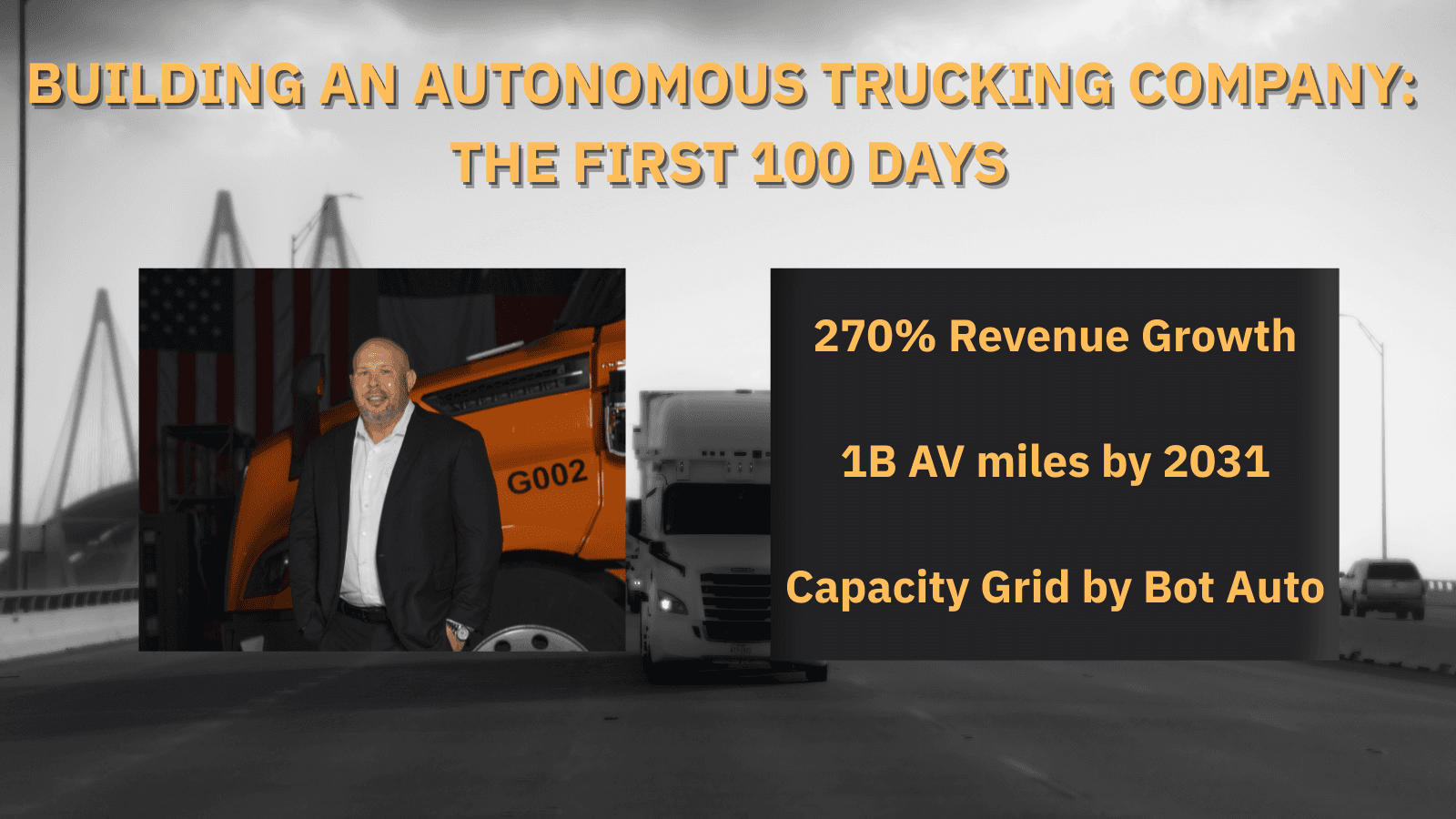
We are already beginning to see that transition take hold. From May to August, Bot Auto increased revenue by 270% as we put greater emphasis on commercial freight and productive utilization of the fleet. That matters because our goal isn't simply to accumulate autonomous miles. It is to turn those miles into productive capacity that customers value and will pay for.
Over these first 100 days, we have also put a stake in the ground for what scale means: one billion autonomous miles in 2031.
That isn't simply a mileage target. It forces us to work backward from the transportation system required to produce a billion productive autonomous miles. How many tractors does that require? Which markets need to be connected? Where does capacity need to be positioned? How much freight density is required? What infrastructure supports it? And how do we orchestrate all of it as one network?
Our answer is the Capacity Grid Powered by Bot.
The Capacity Grid won't appear all at once. We are building it sequentially. We start by commercially validating individual lanes, then connect those lanes into corridors, connect corridors through strategic markets, and continue adding origins and destinations until what began as individual autonomous routes becomes an interconnected transportation network.
Each addition should make the network more useful. A new lane doesn't simply add miles; it creates new ways for capacity to move through the existing Grid. A new market can create multiple new origin-and-destination combinations. As density builds, capacity becomes increasingly fungible across the network rather than tied to a single route.
That is how we intend to get to a billion autonomous miles—not by deploying autonomous trucks and then searching for freight to keep them busy, but by deliberately building the network and commercial demand that allow autonomous capacity to scale with it.
This is also why removing the driver doesn't remove the fundamentals of trucking. In many ways, it makes them more important. An autonomous truck potentially removes one of the largest constraints that has governed trucking for more than a century: the productive hours available from the human being inside the truck. But removing that constraint only creates value if the transportation network can keep the asset productive.
Customers don't ultimately need autonomous trucks. They need dependable transportation capacity at the right place, at the right time and at an economically attractive price. Autonomy gives us a fundamentally new way to produce that capacity. The Capacity Grid is how we intend to deliver it.
When I look at my first 100 days at Bot Auto, I see three chapters of my career beginning to converge. Knight taught me how to scale transportation. Loadsmith taught me how to move quickly, challenge incumbents and use technology to deliver innovation to customers. Bot gives us the opportunity to combine those lessons with an extraordinary autonomous driving system and an AI-native company built for this moment.
My first 100 days haven't convinced me autonomous trucking is going to work. I came here because I already believed that. What they have reinforced is my conviction about how it should be built—and given us a clear destination for where we intend to take it.
The autonomous truck is the technology. Capacity is the product. The Capacity Grid Powered by Bot is how we intend to deliver one billion autonomous miles—and ultimately autonomous capacity at scale.