Navigating the Diesel Spike as a Small Fleet with Autonomous Superpowers
David Stemm
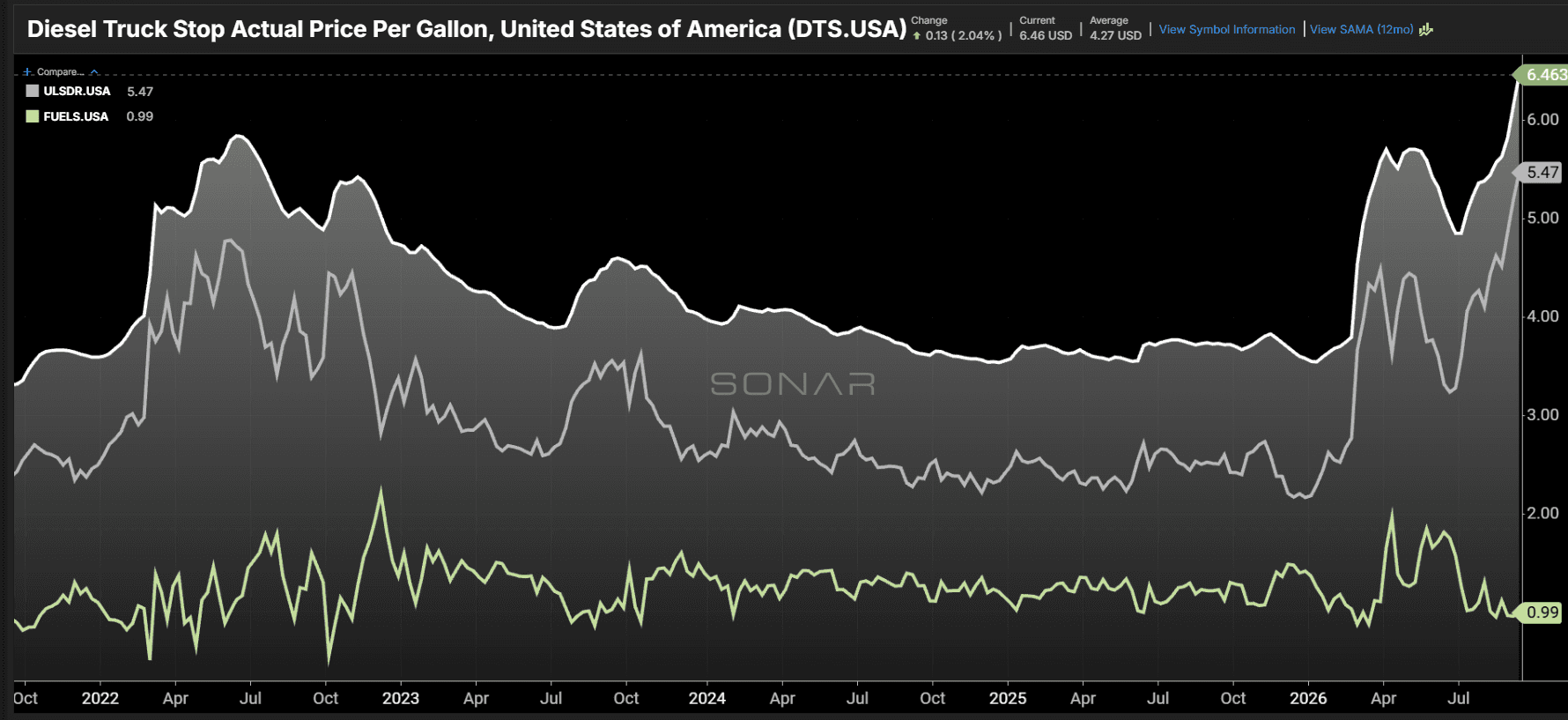
Diesel prices have been on a steady increase since early 2026, and the recent record-high prices are once again testing the resilience of the trucking industry. Over the past six weeks, diesel prices at the pump have moved sharply upward, squeezing operational margins and leaving small fleet owners with little room for error. As fuel expense dilutes operating margin, surviving the storm requires discipline across three fundamental pillars of fuel management: purchasing and procurement , fuel cost recovery, and fuel efficiency.
Industry outlet FreightWaves recently published a market analysis about how the rising cost of fuel is squeezing carriers' margins, highlighting the fact that even giant fleets like J.B. Hunt are feeling the pain of high prices.
While purchasing and recovery are heavily subject to market leverage and contract terms, efficiency remains the one variable a fleet can directly influence on the road. Efficiency is also the variable directly correlated with autonomous driving operations.
High diesel prices aren’t an insurmountable crisis to the Bot Auto fleet, rather an opportunity to prove our operating strategy works.
Once our autonomous driving system is engaged on the highway, our AV technology delivers a profound structural advantage. Because the ADS was purpose-built to replicate the behavior of the best drivers on the highway, the ones that drive with relentless focus on safety, service, and fuel economy, the Bot Auto fleet has a unique operating advantage.
On key freight corridors inside our Capacity Grid, like I-45 between Houston and Dallas, the Bot Mission Driver achieves a 15% increase in fuel efficiency over an average human-driven class 8 truck. The software finds this level of efficiency by executing precisely what master truck drivers do every day.
It operates at locked-in speed set points, maintaining steady cruise speeds with virtually zero variance, strictly observing posted speed limits and capping max speeds at 65 MPH.
The truck utilizes smooth, modeled acceleration, eliminating harsh throttle inputs in favor of optimized, gradual power delivery curves.
It observes consistent following distances, avoiding the constant drag-and-accelerate cycles caused by tailgating or erratic traffic spacing. At the same time, the ADS applies predictive gentle braking, reading traffic patterns far ahead to maximize momentum and minimize unnecessary stops.
The ADS also lives in a stable lane management state, maintaining optimal lane positioning and bias to reduce micro-steering corrections that bleed efficiency.
For small fleets navigating today’s volatile diesel market, 0.1 mile per gallon of fuel saved directly correlates to more margin. While macroeconomic forces will continue to drive diesel price cycles, adopting the driving behaviors of the industry's top 1%, whether through advanced driver training or autonomous driving systems, remains the single most effective lever for taking control of your bottom line.